


Wondering how website design shapes your user experience, and how you can improve it? Your website is like the virtual identity of your brand. If it has an attractive layout, impressive images or videos, clear content, and opens within seconds, that means your user stays longer and explores more.
Your design choices directly influence how users feel and interact with your site. In this blog, we’ll break down a common question: How can I improve my website design? You’ll find practical insights that help you build a site people trust, enjoy, and return to.
Let’s get started!
What’s the main website design element that affects the user experience?
Website design consists of numerous elements. When these elements work together, your website naturally starts performing better on SERPs. This helps users navigate easily and explore your services without confusion. Overall, the first element users interact with is your visual aesthetic. Visual aesthetics include your website’s colors, fonts, and layout. A strong color combination becomes a plus point when you choose it correctly.
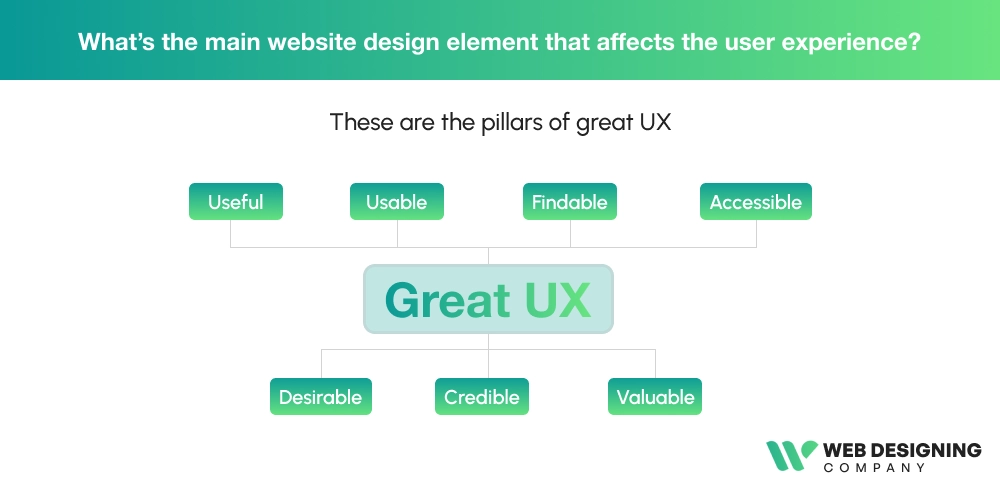
These are the pillars of great UX:
- Useful: Is your product useful to users? Does it solve a real problem or fulfill a need?
- Usable: Is your product or service easy to use, efficient, and intuitive for your target audience?
- Findable: Can users easily locate information or features within the product?
- Accessible: Can people with disabilities access and use the product?
- Desirable: Is the design appealing, with strong branding and aesthetics that evoke positive emotion?
- Credible: Do the product and its creators inspire trust and reliability?
- Valuable: Does it provide real value to both the user and the business?
All these questions can help you understand your brand from a user’s perspective. Apart from that, your website acts as a first impression. If a user dislikes your website for any reason, it signals that your site may not be reliable. That’s why your visuals must be direct, attractive, and attention-grabbing to instantly connect with the user’s pain points.
How Does Smart Design Influence User Behaviour on Your Website?
Improving your web design is not rocket science. Even simple changes can make a big difference. Just keep these points in mind, and you’re guaranteed to boost your growth. Read each one carefully; these points might become the ladder to your digital success.
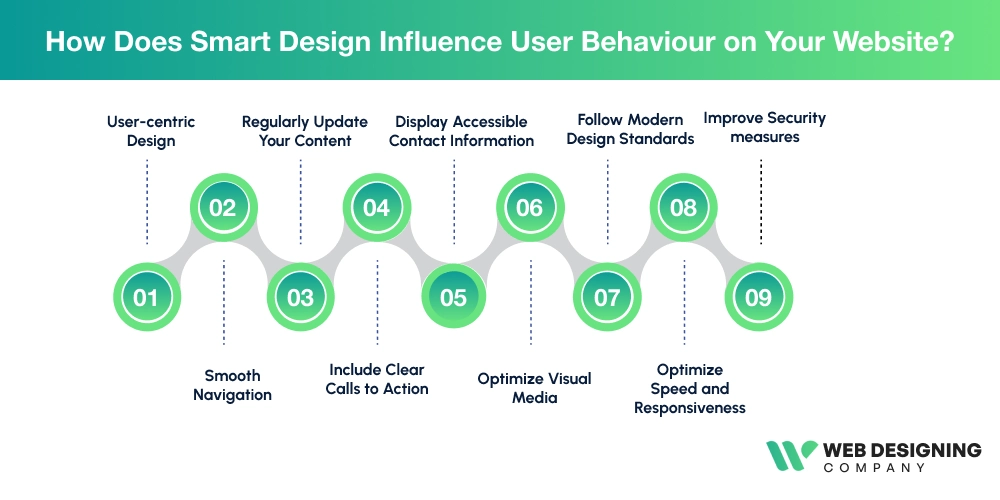
User-centric Design
User-centric design means building a website that completely aligns with the user’s buying journey. If your website design conveys a clear message through every section, message, and interaction, it means your website easily grabs the user’s attention.
For a user-centric design, you need to evaluate your user persona in detail, such as their goals, challenges, motivations, and the questions they ask before making a purchase decision. When your design clearly resonates with these insights, it naturally guides visitors toward the actions they want to take.
A user-centric website feels familiar and intuitive because it’s built from the customer’s point of view, not the business’s. Furthermore, this type of design helps them move confidently from interest to decision. This not only improves user experience but also increases the reliability on you, engagement, and your traffic starts to convert into paying customers.
Smooth Navigation
I have visited a lot of websites daily, and with my personal experience, I can decide within a few seconds whether I want to stay or leave. If I find the menu is simply structured, the pages are easy to reach, and everything feels organized, I naturally end up exploring more. That’s the power of smooth navigation.
Your visitors should be able to move around without stopping to think, “Where do I go next?” Simple menu labels, a clean layout, and predictable page structure make the entire experience feel effortless.
Even small touches, like a visible search bar or well-placed internal links, help users reach what they’re looking for faster. When navigation feels this natural, people spend more time on your site, view more pages, and trust your brand more because the website makes their journey easy instead of confusing.
Regularly Update Your Content
Content is the real bridge between you and your users. It’s how people understand what you offer, why it matters, and why they should choose you. If your content does not match the current searching criteria or it’s too complex to understand, visitors lose interest, and search engines do too.
But if your content is informative, up to date, relevant, and fits in the purchase funnel, users feel like they’re getting the latest, most accurate information straight from you. Daily updates also indicate about your business that you are active and paying attention.
Whether it’s refreshing service pages, adding new case studies, writing blogs, or updating visuals, every change signals that you care about delivering value.
Include Clear Calls to Action (CTAs)
A call to action is simply your way of telling visitors what to do next. However, a CTA is effective only when it captures attention at the right moment. The wording should feel direct and clear, not salesy. And the color you use plays a big part too; if it blends into the page, people won’t even notice it. If it stands out with the right contrast, the eye is immediately drawn to it.
Think about how users move through your site. They read, scroll, and pause, and in those moments, your CTA should stand out clearly. This is where you catch their attention at the exact moment they’re ready to act.
A good CTA doesn’t force someone; it simply gives them a clear next step. And to make that step even more effective, you can experiment with your CTAs. When the message and the color work together, users don’t have to think twice before clicking.
Display Accessible Contact Information
When people visit your website, they want to know who they’re dealing with. But your one step is to flip the whole game. Add a dedaicated page where you provide your business information.
It gives visitors a sense of who you are, how you work, and why they can trust you. When you share your real contact details along with a photo of yourself or your team, it immediately makes the experience more personal.
You can also talk about your journey and how you reached your current position. This kind of story helps users see the effort and passion behind your work, and it makes them feel more connected to you.
As a result, they understand you better and feel more confident when making a decision. Trust grows naturally when people see the human side of your business.
Optimize Visual Media
As per human psychology, visuals attract attention instantly. So, it’s essential to add strong visuals that make your website feel alive. Clear pictures and engaging videos are important elements that enhance the user experience rather than slow it down.
It’s important to compress your files into WebP (a file format) before uploading them. When images and videos are optimized, they load quickly while still looking sharp. These small efforts help your website stay quick and responsive.
Your users enjoy the visuals without dealing with long loading times, and you get the benefit of a site that looks good and performs well at the same time. The goal is simple: make your website visually appealing while keeping the speed intact.
Follow Modern Design Standards
If your website is still built in a boring and outdated design, it can quietly hold you back. Users notice it instantly, and many leave without giving the content a chance.
In other terms, modern design is your chance you meet the people’s expectations that they already have from the websites they use every day. It’s important to note that modern designs include clean layouts, readable fonts, balanced spacing, and simple navigation. These all play a part in how your site feels.
When you follow today’s design standards, your website automatically becomes seamless and more authentic. The results? Your visitors feel comfortable exploring because the experience matches what they’re used to.
Updating your design is not just about looking fresh; it’s about keeping your website aligned with the way people browse and interact now. A modern design sets the tone before a single word is read.
Optimize Speed and Responsiveness
Speed is something you simply can’t compromise on. When a website takes more than 2 seconds, users immediately leave your website and move to your competitors. It doesn’t matter how strong your brand is.
A fast website feels effortless. Pages take less time, images load without delay, and users can move from one section to another without any friction. Along with speed, your site must respond well on every device.
It’s unpredictable which devices your users are using. All in all, people switch between mobiles, tablets, and laptops throughout the day, and your website should adapt smoothly to all of them.
When your site is both fast and responsive, users stay longer, explore more, and feel confident about your business. It shows that you value their time and that alone improves their entire experience.
Improve Security measures
Strong security is the backbone of a healthy website. When you put the right protections in place, you safeguard your business and your customers from hackers and data breaches. Start with an SSL certificate. This helps you to encrypt sensitive information and prevents unauthorized access.
Strengthen your login systems with secure passwords and two-factor authentication, and make sure your software, plugins, and themes stay updated at all times. A well-secured website builds trust, protects your reputation, and gives users confidence every time they visit.
A Quick Boost for Your Website Design: Optimize for a Better User Experience
Optimization of your website is like the final polish. Undoubtedly, after following the points, your website is now great visuals and strong content, but if the site doesn’t run smoothly, users leave it right away.
Optimization fills the gap. During the process, every part of your website is optimized. It includes everything from your site load speed to layout, or how it behaves on different devices; the whole experience becomes easier for your visitors.
An optimized site loads quickly and responds the moment someone taps or clicks. It shows users that you value their time and want their journey to be comfortable. This simple effort makes a big difference because people always remember a website that feels effortless to use.
The Secret Sauce to Better Website Design: Test, Test, and Test
If there’s one habit that separates an average website from a high-performing one, it’s testing. Nothing stays perfect forever, and user behavior keeps changing, so the only way to stay ahead is to check how your website actually performs in real situations.
When you test regularly, you start noticing small issues that you may have missed before, like a CTA that people are skipping, a page that loads slowly, or a layout that doesn’t feel right on mobile.
Testing helps you understand what works and what doesn’t. You can experiment with different headlines, colors, layouts, or button placements and see what your audience responds to.
Over time, these small improvements add up and create a smoother, more engaging user experience. Continuous testing keeps your website sharp, relevant, and ready to convert, and that consistency becomes your quiet but powerful advantage.
Whether you’re running a small blog or a big website, the CMS software can easily handle more pages, posts, and features as you grow.