


If you want to offer your products or services online, a website acts like your digital store. Web development is a way to establish your online presence, build brand awareness, and engage with customers in this digital age.
For developing your website, you can’t hire just anyone. For this, you need a skilled, trained professional who already has experience with websites.
Table Of Contents
What is web development?
Can anyone build a website, or do you need a professional?
A brief overview of the web development process
How much does web development really cost?
How to choose a web development agency for your needs?
Work with our web development pros and grow your business
What is Web Development?
Web Development is the process of developing and maintaining websites or web pages for the digital store. From vision to reality, front-end and backend developers are the creators who give the digital shape to the website.
The languages used to build pages are HTML, CSS, and JavaScript. A frontend developer works on the client side and deals with everything related to how a website looks and interacts. Backend, on the other hand, is the server side of a website. It handles the underlying logic, databases, and server configurations that users don’t see.
After frontend and backend developers lay the basic foundation, the design, content writing, and marketing come into play. Apart from this, web development also includes other aspects such as content management, e-commerce management, website migration, security configuration, and more.
Can Anyone Build a Website, or Do You Need a Professional?
Without proper educational training, it’s not possible to build a website the right way. Website development needs a professional agency like a Web Designing Company that has hands-on experience and understands how every part of a site works.
They know how to write code from scratch, apply the right logic, and make sure the website runs smoothly without errors. A skilled developer can turn ideas into a functional, secure, and high-performing website, something that’s hard to achieve without real technical knowledge.
Thus, it is clear that not everyone can do website development and design; you need an in-house and seasoned player for better outcomes.
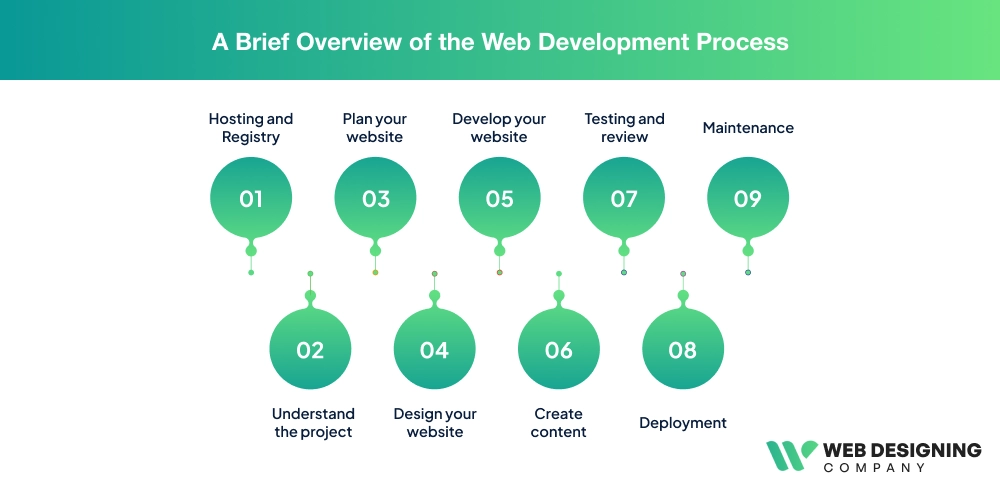
A Brief Overview of the Web Development Process
Developing a website has multiple processes. Here, we are breaking down the process into the simplest form. The reason behind doing this? If you are a beginner and don’t know where you need to start, our high-level overview helps you understand. Let’s get started.
Hosting and Registry
Hosting and registry are mandatory early in the project. Hosting allows your website to be accessible on the public internet, primarily because it gives a public location. Whereas a registry means giving your website a unique domain name that becomes memorable for the user, and they can find and interact with it.
Understand the project
The very first step in the website development process is understanding the complete vision behind the project.
Business Details: This includes getting the full business details, such as what the business offers, the main purpose of building the website, the unique value they provide, and their mission.
Know about the target audience: Once it’s clear what the client wants, the next step is analyzing who their target audience is. This involves researching their preferences, likes, dislikes, online behavior, and what they expect when they visit a website.
Competitor Analysis: Along with audience research, analyzing the competition is foremost. Checking what competitors are doing well, where they are lacking, and what opportunities can be used to build something better. This helps to identify gaps and shape a stronger strategy for the new website.
Plan your website
In the second and crucial step, it is the planning stage. This is where everything starts taking shape. We look at what the website should include and how each page should be arranged. From the homepage and landing pages to product or service pages, blogs, and the contact area, every section is planned with a purpose.
During this step, we also think about how a user will move around the site. A clear and concise sitemap helps the search engine access all the pages, and visitors can quickly find what they are looking for without feeling lost. Moreover, well-planned structure, menu style, categories, and where the most important information should go are all important factors of planning.
Parallelly, checking the technical side, like which platform will fit best, what features are needed, and if the website requires any customizations. This planning stage essentially serves as a blueprint. Once this part is clear, the development becomes much smoother, and it helps your conversion funnel and user journey for each page of your website.
Design your website
Once the planning is done, the next step is to bring everything to life visually. With the custom web design part , it introduces the branding elements, such as the color palette, logo, and iconography, to the image and videos you’ll use. This stage is the transformation of your blueprint into the functional features.
The branding elements used on the website remain the same across social media pages, marketing material, newsletters, and more. For more understanding, let’s say a designer is working on an education portal. So, they may use calm colors and clean layouts, while an e-commerce store may focus on bold visuals and product-focused design. The logic behind this is human psychology. Colors play with human psychology.
Apart from this, your website’s design also impacts your user interface (UI) and user experience (UX). It’s important that your website is responsive, which helps your website be easily accessible on any screen, highly user-friendly, and easy to navigate.
Develop your website
Once everything is set, the next part is coding. Writing code is the technical part where developers use a variety of programming languages like HTML, CSS, and JavaScript. Each website has different coding as each website has different functionality.
This process needs frontend and backend developers, or full-stack developers (who know both frontend and backend). They give the final shape to the website, considering the designs, wireframes, and other elements from the previous phase.
Undoubtedly, the coding phase has comprehensive tasks. It includes writing code to setting up server-side functionality. If the website is new, the developer writes the code from scratch. In this scenario, they use pre-existing tools or frameworks to speed up the process.
Moreover, developers also deploy site plugins and add security integrations that protect the website from hackers. Once the coding is done, it’s ready for testing.
Create content
Good design needs strong content to support it. Now, this task is taken over by the SEO and content writing team. The SEO team analyzes the competitors, researches the keywords, and pipelines the content strategy. This includes:
- Web copies
- Blog posts
- Guest posting
- Landing pages
- Product or service descriptions
- Case studies
- Videos
- Infographics
- Newsletters
- White papers
- Social media posts
All this content is based on what your target audience is looking for. Content should guide visitors, answer their questions, and build trust. For instance, a service-based business might add case studies or FAQs to help users make quicker decisions.
Testing and review
Once your website is built, it enters the testing and review phase, a step many people overlook, yet it’s the one that saves you from headaches later. Testing and reviewing is like giving your site a final health check before you push it live.
At this stage, every page, button, and feature is inspected to make sure it works exactly as expected. Developers test loading speed, responsiveness, browser compatibility, and overall user experience. If something feels off, even a tiny glitch, it’s fixed on the spot.
This is also when content, design consistency, and SEO basics are reviewed to ensure everything aligns with your brand. In short, testing connects the dots between creativity and functionality. It’s the moment where your website shifts from “almost ready” to a platform that feels polished, reliable, and ready for real users.
Deployment
Deployment is the moment when your website is finally live. After all the planning, designing, coding, and testing, this is where everything comes together. Your site is transferred from the development environment to the live server, where users can access it anytime.
During deployment, developers ensure the server settings, domain configuration, and security layers are set up correctly. A small misstep here can cause trouble, so every detail is double-checked.
And even though deployment feels like the finish line, it’s really the start of your website’s real journey. From here on, your site begins interacting with actual users, collecting insights that guide future improvements.
Maintenance
Maintenance is where your website stays healthy, updated, and ready to deliver a smooth experience every single day. Once the site is live, the real work begins behind the scenes.
Just like a car needs regular servicing to run without trouble, your website also needs ongoing care. This includes updating plugins, fixing bugs, improving performance, and making sure security measures stay strong.
Over time, user behavior shifts, and so do the trends. So, the website should be updated from time to time with new features. Moreover, maintenance helps your website adapt instead of falling behind. It also ensures that any small issues are caught early, preventing bigger problems down the road.
How Much Does Web Development Really Cost?
The website development cost is not the same for every project. It varies according to the project’s requirements. The reason? Every project has a different purpose, unique design needs, and feature lists.
Generally, factors like what type of website you want, the number of pages, and whether you need a basic feature or an advanced custom function affect the price. A simple website will cost less, while an e-commerce store or a custom platform naturally costs more.
Another factor that affects your final cost is design complexity, your content requirements, integrations, and how much of the backend work is done. So, instead of giving a fixed number, we have provided scenarios that are added to the basic cost.
It’s always better to share your requirements first. Once your goals and expectations are clear, a proper cost estimate can be given, so you get a budget that matches your website needs, not a random number.
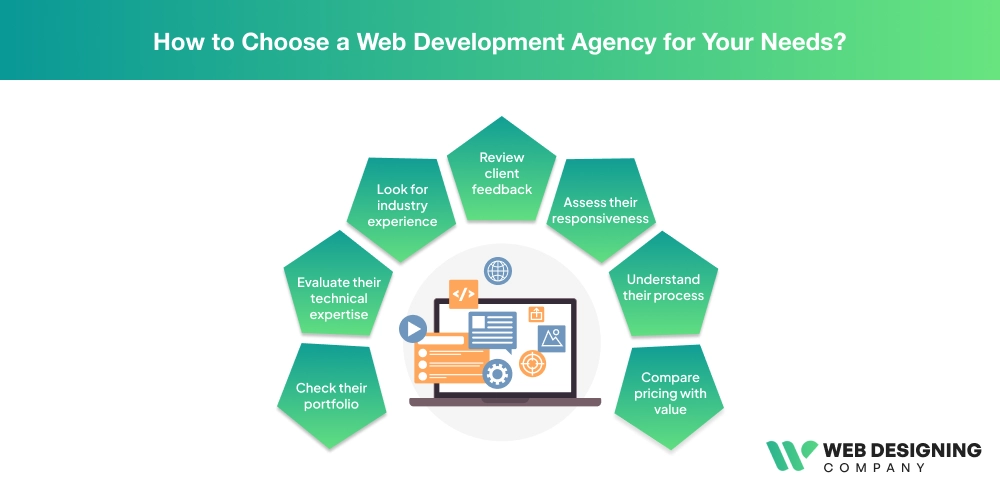
How to Choose a Web Development Agency for Your Needs?
Finding the exact match is actually challenging. The search process becomes even tougher when numerous agencies are competing with each other, each promising big results, and you’re unsure who can truly make the most of your investment. To help you cut through the noise, we have a tactical solution to simplify the process, and your search ends with our guide.
Check their portfolio: First and foremost, check the agency’s profile. See who they work with, what they bring to the table, and get an idea of how they think, design, and execute real projects.
Evaluate their technical expertise: Through calls or technical assessments, check their core skills. This step ensures their skill set aligns with the features and complexity you need.
Look for industry experience: Experience matters when it comes to handling complexity and adding custom features. An agency that understands your domain will deliver faster and more effectively.
Review client feedback: Check platforms like Google, Clutch, Upwork, Fiverr, and PeoplePerHour for client reviews. This gives you clarity on their professionalism, communication style, and delivery quality.
Assess their responsiveness: Quick, clear replies are a strong sign of reliability.
Understand their process: If an agency passes the above criteria, congratulations! Now, check whether they have a transparent workflow. Transparency helps save time, avoids confusion, and ensures smoother collaboration.
Compare pricing with value: Don’t chase the lowest cost; focus on the agency that offers the best return on your investment.
Work With Our Web Development Pros and Grow Your Business
Web development is a crucial process for any agency. It’s like spending your hard-earned money on the right agency. There are many cases where agencies take the money and then ghost their clients. And for startups, it’s like someone plucks the seed before it grows. That’s why agencies must be reliable.
At our Web Designing Company, we have extensive experience in web development. In fact, we have a team of developers, testers, SEO consultants, content writers, and designers. We are a one-stop shop where you get each service backed by industry experts. Our web development agency uses advanced tools and plugins to secure your website. Moreover, your website is user-friendly, which helps reduce the bounce rate.
Want to know more about our services and packages? Get in touch with our Web Development Experts.