

When you set up an online store, two terms usually come up first: web design and web development.
Many business owners feel confused at the beginning, especially if they are new to building a website. Although these two terms sound similar, they are very different.
Web design and web development are vast fields, and many myths and misconceptions surround them. Clearing this confusion at an early stage gives you peace of mind and helps you plan your budget more effectively.
In this article, we will discuss and debunk some of the most common myths related to web design and web development. This guide is specially created for startups and beginners who want to understand how development really works.
Read until the end to clear your misconceptions – all in one place.
Web Design vs Web Development: Know the Real Difference
For a successful website, web design and web development are two crucial elements that support business growth. One defines the visual appearance and structure of the site, while the other builds the technical foundation that makes it work. Understanding the difference between the two is essential for creating an effective and reliable website.
Web Design
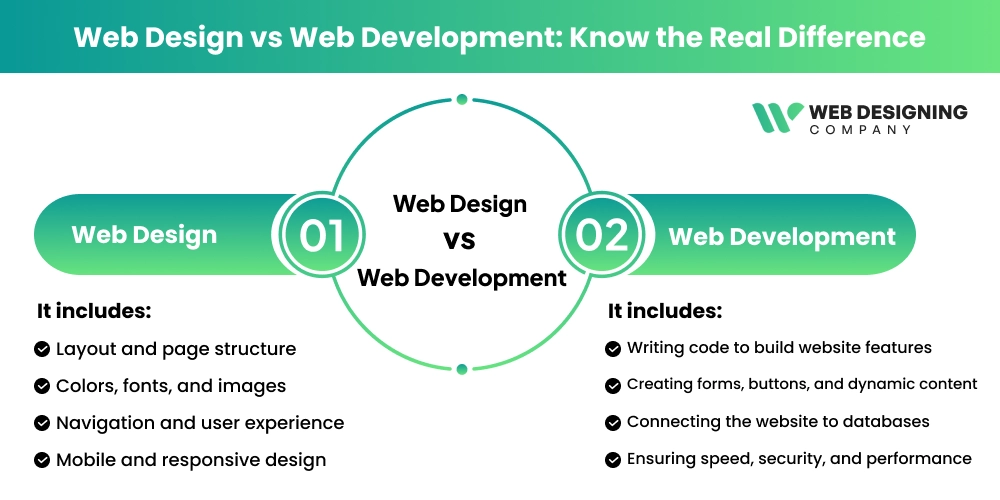
Web design is the process of shaping how a website looks and how users interact with it. It focuses on elements users engage with, such as layout, colors, typography, images, and navigation.
It also ensures that the website looks visually appealing, delivers a seamless experience, and guides visitors smoothly through the content. Since design is the first thing users notice, it plays a key role in creating a strong first impression and building trust.
It includes:
- Layout and page structure
- Colors, fonts, and images
- Navigation and user experience
- Mobile and responsive design
A web designer ensures the website is visually appealing and easy to use. Their goal is to create a design that attracts users and helps them find information quickly.
Web Development
On the other hand, Web development is a comprehensive process of creating, building, and maintaining a website. It works behind the scenes. It involves writing code, a combination of the frontend, backend, and database management tasks, that turns design into a functional website.
Web development ensures that features like forms, buttons, databases, and user interactions work smoothly. It also handles performance, security, and scalability, making sure the website runs fast, stays secure, and can grow with business needs.
It includes:
- Writing code to build website features
- Creating forms, buttons, and dynamic content
- Connecting the website to databases
- Ensuring speed, security, and performance
A web developer turns the design into a functional website. They make sure everything works smoothly when users interact with it.
Web Design vs Web Development: The Truth Behind Common Myths
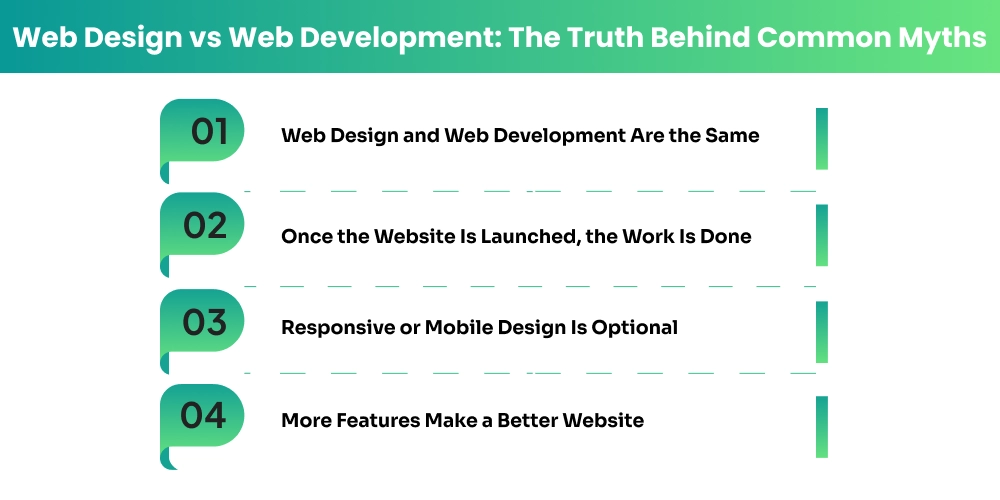
1. Web Design and Web Development Are the Same
This myth is very common. And honestly, it’s easy to see why. Both work on the same website. So people assume they do the same job. But that’s not true.
Let’s break it down.
Web design is about how a website looks and feels. It handles the layout. The colors. The fonts. The navigation. It focuses on user experience and first impressions.
Web development is about how the website works. It involves coding. Functionality. Performance. And integrations. This is the part users don’t see. But they feel it when something works smoothly.
Here’s the key point. A website needs both.
Good design without development won’t function properly.
Strong development without design won’t engage users.
That’s why web design and web development are different. And equally important.
2. Once the Website Is Launched, the Work Is Done
Many people believe the job ends once a website goes live. The site is built. It looks good. Everything works. So the work must be finished. Right?
Not really.
In reality, launching a website is just the beginning.
Websites live in a changing environment. Browsers update often. Devices change every year. User behavior keeps evolving. What works today may not work six months later.
Security is another big factor. According to industry reports, most website vulnerabilities come from outdated plugins and software. Regular updates help prevent these risks.
Performance also needs attention. Slow websites lose users fast. Studies show that even a one-second delay can reduce conversions significantly. Speed matters.
Then there is content. Information gets outdated. Offers change. Search engines prefer fresh and relevant content. Without updates, rankings drop over time.
- That’s why ongoing maintenance is essential.
- Updates keep the site secure.
- Optimization keeps it fast.
- Content keeps it relevant.
A website is not a one-time project. It’s an ongoing process.
3. Responsive or Mobile Design Is Optional
This used to be true. Not anymore.
Today, most people browse websites on their phones. In fact, over half of global web traffic comes from mobile devices. That alone changes everything.
Now think about this. A user opens your website on a small screen. The text is hard to read. The buttons are too close. The layout breaks. What happens next? They leave. Fast.
Search engines notice this behavior. That’s why mobile-friendly websites rank better. Google follows a mobile-first approach. It looks at the mobile version of your site before anything else.
- Responsive design solves this problem.
- It adapts the layout to every screen size.
- It improves readability and navigation.
- It creates a smoother user experience.
In short, mobile design is not optional. It’s a basic requirement.
4. More Features Make a Better Website
This sounds logical at first. Many businesses assume that more features mean more value. In practice, it often does the opposite.
When a website has too many features, it becomes heavy. Pages take longer to load, navigation feels cluttered, and users struggle to find what they are actually looking for. As confusion increases, engagement drops, and so do conversions.
Additionally, every extra feature means more code and more maintenance. This increases the chances of technical issues and directly affects speed and stability. Slow websites rarely convert.
- A better website focuses on what truly matters.
- The right features.
- Clear user journeys.
- Specific business goals.
Simplicity improves speed, usability, and overall experience. When everything has a purpose, the website performs better and converts more effectively.
5. A New Design Automatically Boosts Traffic
This is a common belief. Redesign the website, and traffic will follow. It sounds simple. But that’s not how it works.
A new design can improve first impressions. It can make the site look modern and trustworthy. But design alone does not bring visitors.
Traffic mainly comes from search visibility and content quality. Studies show that over 90 percent of online experiences begin with a search engine. If your website is not optimized for search, then users will not find it, no matter how good it looks.
Performance also plays a role. Slow websites lose rankings and users. Even a small delay can reduce engagement and conversions.
Marketing matters too. Without consistent SEO content promotion and optimization, a redesigned website often stays invisible.
A good design supports traffic growth. It does not create it on its own.
6. Web Development Is Overly Expensive
This concern comes up in almost every project discussion. Web development feels expensive at first glance. But the problem is not the cost. It’s the planning.
Development costs depend on what you are building and how far you want it to scale. A simple website costs less. A platform built for growth costs more. The difference lies in long-term goals.
Many studies show that fixing issues after launch costs significantly more than building it right from the start. Poor development leads to performance problems, security risks, and frequent rebuilds. That is where real money is lost.
Strategic development focuses on clean code, speed, and scalability. It reduces future issues and saves time later.
Good web development is not an expense.
It is an investment that protects your business as it grows.
7. The Homepage Is the Most Important Page
This is one of the biggest myths in website planning. The homepage matters. But it is not the only page that deserves attention.
Think of the homepage as an entry point. It introduces your brand and guides visitors. But most users do not always land there first. Many arrive through service pages, blog posts, or product pages from search engines.
Search data shows that internal pages often drive more organic traffic than the homepage. That is because users search for specific answers, not brand names.
Yes, your homepage should look attractive. It works like a menu. But a menu alone does not make a restaurant successful. Every page must be clearly optimized and useful.
- Service pages build trust.
- Content pages attract traffic.
- Product pages drive conversions.
When every page is treated as important, the entire website performs better.
How Web Design and Web Development Work Together
Web design and web development never work in isolation. They move together from start to finish. One cannot succeed without the other.
The designer decides how the website should look and feel. This includes layout, colors, spacing, and user flow. The goal is to create something clear, engaging, and easy to use.
Then the developer steps in. They turn those ideas into a working website. They write the code. They built the structure. They make sure everything loads fast and functions smoothly across devices.
Think of design as the blueprint and development as the construction. A great plan means nothing if it cannot be built. Strong development also fails if the experience feels confusing or outdated.
When both work together, the result feels seamless.
The website looks good.
It works well.
And users enjoy using it.
Final Verdict!
In this blog, we covered the key differences between web design and web development and debunked the most common myths surrounding both. The aim was to give you clarity, help you avoid common pitfalls, and enable you to make informed decisions when building your website.
If you’re still confused, we’re here to help. As a web development consultant, we guide you at every stage of the process. We create websites that not only users love but also search engines can easily understand and rank.
If you’re looking for a reliable partner for both design and development, feel free to contact us; we’d be happy to help you move forward with confidence.
Frequently Asked Questions About Web Design vs. Web Developers
01 Which is better, web design or Web Development
Neither is better on its own. Web design focuses on user experience and visual appeal. Web development ensures functionality, performance, and scalability. A successful website needs both to work together. Choosing one over the other limits growth and effectiveness.
02Is Web Design Still in Demand in 2026
Yes. Web design remains in strong demand in 2026. Businesses rely on clear user experiences, mobile-friendly layouts, and strong visual identity. Good design directly impacts engagement, trust, and search rankings, making it a critical skill for digital success.
03Do Small Businesses Need Both Web Design and Web Development
Yes. Even small businesses need both to succeed online. Design helps attract and engage visitors. Development ensures speed, security, and smooth performance. Ignoring either can lead to poor user experience, lost trust, and fewer conversions.