

Thinking about building an e-commerce website, but unsure how much it might cost?
For your convenience, we have prepared a detailed overview of e-commerce website pricing. This information is based on research, expert insights, and the key factors that influence development costs.
The cost of an e-commerce website can range from $0 to $250,000+, depending on several factors such as the platform you choose, the level of customization, and the complexity of your business requirements. For small businesses, the cost usually varies based on their specific needs.
Keep in mind that this is only an overview, since the final cost depends on the features and functionalities you want to include.
In this blog, we aim to provide a clear cost breakdown so you can better understand how much budget you may need.
Let’s get started!
How Much Does an E-commerce Website Cost?
New technology has changed the way people buy and sell. Today, customer experience plays a major role in online business success. Two decades ago, most people were not familiar with terms such as fast loading speed, responsive design, clear site structure, crawlability, and search rankings. Now, these elements have become essential for any online store.
Today, both buyers and sellers are comfortable with online shopping platforms. Because of this, many business owners are willing to invest in an e-commerce website. However, the cost of building an e-commerce website depends on several factors.
These include the size of your business, the unique features you want to offer customers, and the level of customization that requires development work.
In many cases, some businesses start with a simple structure and only a few features. Others require advanced functionality, integrations, and a scalable system to support long-term growth.
Generally, backend development alone can range from under $5,000 to $500,000, depending on the complexity of the project. The simpler and more template-based your website is, the lower the cost will be.
However, if you want a website that fully represents your brand and includes advanced capabilities, the investment will naturally be higher.
Below is a simple breakdown that most businesses can use as a reference.
| Business Size | Cost |
|---|---|
| Starter e-commerce website | $500 – $3,000 |
| Small Business store | $3,000 – $10,000 |
| Professional e-commerce website | $10,000 – $30,000 |
| Enterprise Level Stores | $30,000+ |
Typical price range:
1. Starter E-commerce Website
This type of e-commerce website is suitable for startups or small sellers launching their first online store. It usually includes a basic template design, limited product listings, a standard checkout system, and essential functionality. Because of this, it is the most affordable e-commerce website option.
2. Small Business Store
This type of website is ideal for growing businesses that need a more professional layout. It often includes custom design adjustments, improved user experience, product categories, payment gateway integration, and basic SEO setup.
3. Professional E-commerce Website
A professional e-commerce website is more expensive and is suitable for established businesses. These stores are better optimized and have improved UI/UX to guide users smoothly through the website. In addition, they include advanced features, third-party integrations, performance optimization, and a scalable architecture.
4. Enterprise-Level Store
These e-commerce websites are built for large brands or high-traffic businesses. The cost is higher than the other website types because they include complex functionality, custom development, automation, advanced security, and integration with multiple systems.
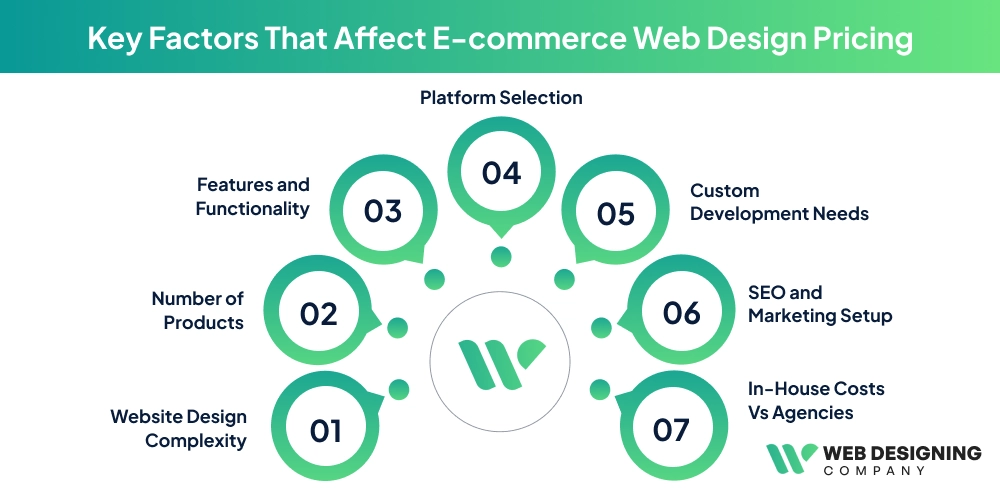
Key Factors That Affect E-commerce Web Design Pricing
E-commerce website costs are not fixed. Every store requires a different level of design, technology, and scalability. Pricing is usually determined by a combination of technical scope, user experience, equipment, and long-term growth needs. After knowing the factor, thiswill helps the busines sto estimate the accurate budget before the development starts.
1. Website Design Complexity
Design is one of the largest cost drivers in an e-commerce project. Template-based stores are faster and cheaper to launch, while custom designs require more time, research, and testing.
A basic template setup may take 20-40 development hours, but a fully custom UI/UX design can require 120+ hours, especially when user journeys, mobile optimization, and conversion-focused layouts are involved.
Businesses investing in custom design often see better engagement and conversion rates because the experience is built specifically for their audience and brand.
Key elements that increase cost:
Custom UI/UX strategy and wireframing
Mobile-first and responsive design optimization
Brand-focused visual identity and layout system
2. Number of Products
The size of the product catalog directly impacts development time and system architecture. A store with 20 products is relatively simple, but a store with thousands of SKUs requires stronger infrastructure and database planning.
Larger catalogs often:
- Advanced product filtering and search
- Category hierarchy planning
- Bulk product management systems
- Faster database queries for performance
3. Features and Functionality
The more unique functionality and personalized features an e-commerce website needs, the higher the cost. Many modern online stores go beyond simple product listings and checkout systems.
Common features that impact pricing:
- Multiple payment gateway integrations
- Smart product filters and advanced search
- Multi-vendor or marketplace functionality
- Subscription or recurring billing systems
- Custom checkout optimization for higher conversions
Industry studies show that adding advanced features can increase development costs by 30%–60% compared to a basic e-commerce store.
4. Platform Selection
The platform used to build the store significantly affects both upfront and long-term costs. Each platform has different pricing structures, flexibility levels, and development requirements.
Popular e-commerce platforms include:
Shopify – Subscription-based platform with faster setup but additional app costs.
WooCommerce – Flexible and cost-effective, but requires hosting and ongoing maintenance.
Magento – A powerful enterprise platform with higher development costs.
BigCommerce – a scalable SaaS solution often used by growing brands.
For example, SaaS platforms usually reduce initial development time, while open-source platforms may require more customization and technical resources.
5. Custom Development Needs
Many businesses require integrations with existing systems such as CRM software, inventory tools, or marketing platforms. Custom development increases project complexity and cost because developers must build, test, and secure these connections.
Get a True E-commerce Website Cost Estimate Based on Your Requirements.
Are you planning to launch your online store? If yes, then every e-commerce business has unique requirements, and the final cost depends on the business features, platfrom and the growth goals.
Examples include:
- API integrations with ERP or inventory systems
- Custom dashboards or internal tools
- Third-party service integrations
- Performance optimization for high traffic
Projects involving heavy custom development can increase budgets by 40% or more compared to standard builds.
6. SEO and Marketing Setup
A properly structured e-commerce website is built with search visibility in mind from the beginning. SEO implementation during development helps avoid costly fixes later.
This typically includes:
- Technical SEO setup (site structure, schema, speed optimization)
- Keyword-focused product and category pages
- On-page optimization for search engines
- Analytics and tracking setup for performance measurement
Research shows that websites built with SEO foundations during development perform significantly better in organic search compared to sites where SEO is added after launch.
7. In-House Costs Vs Agencies
Another factor that affects the cost is whether you have in house team or freelancer, or an agency. If your project is managed internally, it means it offers greater control and long term ownership but require to invest your own company’s resources to polish the talent that takes time.
On the other hand, when you hire the agencies, it means you tap into the already specialized team, expertise in design and development, and faster execution. But this is a bit costly.
And when you are thinking of hiring the freelancer, the person works alone on the project, and might have limited tool which means your project is hampered somewhere.
In all these, it upto you who you hire. Obviously, your choice depends on your budget, internal capabilities ad project complexity and should align with your long-term ecommerce strategy, not just launch timeline.
Here is the quick hack: whether you are hiring the agency or a freelancer, check their portfolio, talk with their previous clients, and then proceed further.
E-commerce Website Pricing by Platforms
The platform you choose has a direct impact on both the initial development cost and the long-term expenses of running your online store. Each platform follows a different pricing model. Some charge monthly subscription fees, while others require investment in hosting, customization, and development.
Below is a practical breakdown of what businesses typically spend on major e-commerce platforms.
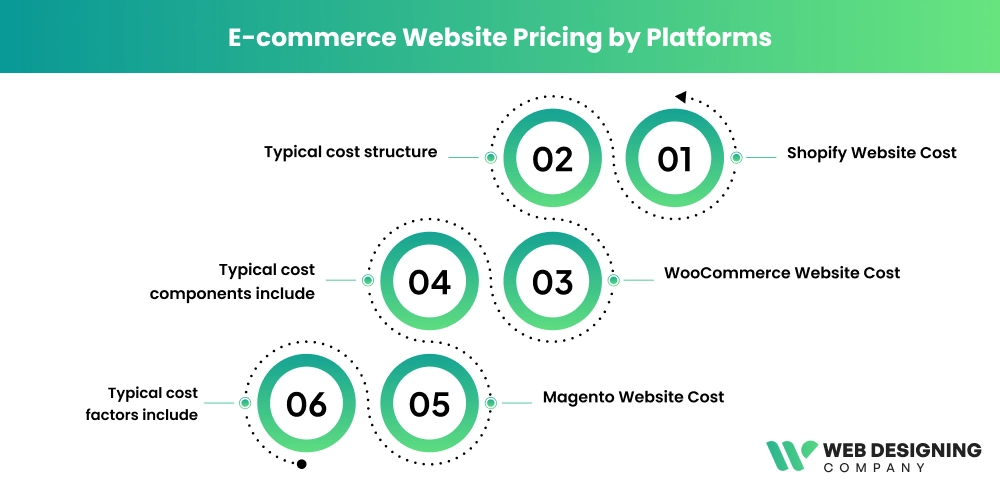
Shopify Website Cost
Shopify is one of the most popular platforms for launching an e-commerce store quickly. It is a hosted solution, which means hosting, security, and updates are handled within the platform. However, costs can increase as businesses add premium features and integrations.
Typical cost structure:
Subscription plans: Usually range from about $39 to $399 per month, depending on features and business size.
Theme cost: Free themes are available, while premium themes generally cost $150 – $400 as a one-time purchase.
App integrations: Many stores rely on paid apps for marketing, analytics, subscriptions, and automation. Businesses often spend $50 – $300+ per month on apps as they scale.
For many small to mid-sized businesses, the average Shopify store setup cost ranges between $1,500 and $10,000, depending on design and customization.
WooCommerce Website Cost
WooCommerce is an open-source e-commerce solution built on WordPress. It offers flexibility and control but requires separate hosting and ongoing maintenance.
Typical cost components include:
Hosting: Quality hosting for e-commerce usually costs $20 – $150+ per month, depending on traffic and performance requirements.
Plugin costs: Many essential features, such as payment gateways, security tools, and marketing automation, come through paid plugins, which may cost $50 – $300+ per year each.
Customization and development: Custom themes, performance optimization, and advanced functionality can significantly increase project costs.
A professionally built WooCommerce website typically falls between $3,000 and $20,000, depending on the complexity of the store.
Magento Website Cost
Magento (now known as Adobe Commerce) is designed for large businesses and enterprise-level e-commerce operations. It offers advanced scalability, complex integrations, and high performance for large product catalogs and heavy traffic.
Typical cost factors include:
Development cost: Magento projects often require experienced developers, which increases development time and cost.
Infrastructure and hosting: High-performance hosting environments are needed for large stores.
Enterprise capabilities: Advanced features such as multi-store management, B2B functionality, and automation systems increase investment.
Magento development projects commonly start around $20,000 and can exceed $100,000+ for enterprise-level stores with custom functionality.
E-Commerce Web Design Cost Breakdown
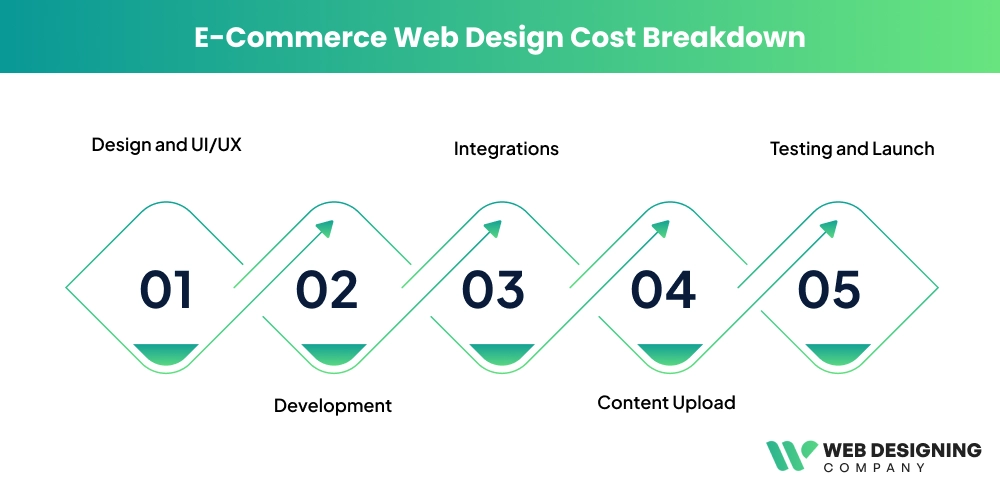
The total cost of e-commerce web design is usually divided into several stages. Each stage requires different levels of expertise, which is why the overall price can vary from one project to another. Understanding this breakdown helps businesses see how their budget is allocated and why costs differ between e-commerce websites.
Design and UI/UX
Design typically accounts for 20%–30% of the total cost. This is a crucial phase that focuses on the overall look, structure, and user experience of the website. It includes research, wireframing, visual design, and mobile responsiveness.
Since design is the first thing users notice when they visit an online store, many businesses invest more in this stage to ensure the website looks professional and provides a smooth shopping experience.
Development
Development usually represents 35%–45% of the total cost and is often the largest portion of the budget. This stage involves building the website, setting up product pages, implementing custom functionality, and ensuring the store works smoothly across different devices and browsers.
Integrations
Most e-commerce stores need integrations with third-party tools. Its’stakeariund 10% to 15% of the budget. These may include payment gateways, shipping providers, CRM systems, analytics tools, or marketing platforms. Integration work ensures the website connects properly with business operations and automation systems.
Content Upload
Testing and Launch
Other Hidden Costs That Affect Your Budget
When building an e-commerce website, there are several additional costs that businesses often overlook. Understanding these expenses in advance helps you plan your budget more accurately and avoid unexpected costs later.
Some common hidden costs include:
Hosting – Reliable hosting is essential for website speed, uptime, and performance.
Maintenance – Regular updates, bug fixes, and technical support keep the website running smoothly.
Security Updates – Security patches and protection tools help safeguard customer data and prevent cyber threats.
Premium Plugins – Many advanced features require paid plugins or apps.
Payment Transaction Fees – Payment gateways usually charge a fee for each transaction.
Marketing Tools – Tools for email marketing, analytics, automation, and advertising may add to ongoing costs.
Want to Know More? Connect With Our SEO and E-commerce Experts
If you would like to understand the exact cost of building an e-commerce website for your business, speaking with experienced professionals can help you make the right decision. Every online store is different, and pricing often depends on your goals, required features, and long-term growth plans.
By consulting with an e-commerce web design agency, you can get a clearer estimate, understand the development process, and choose the most suitable solution for your budget.
Our team has extensive experience in building and optimizing e-commerce websites for businesses of different sizes. We focus on creating scalable, high-performing online stores while offering affordable and flexible packages that align with your business needs.
If you have questions about pricing, features, or the right platform for your store, our consultants are here to guide you and help you plan your project with confidence.