

Landing pages are known search marketing engines that work around the clock, benefiting businesses and their ROI. No matter whether you run ads, email campaigns, or social media promotions, the effectiveness of marketing often depends on how well the landing page grabs the target market’s attention, converting leads or customers.
However, many businesses struggle with the landing page performance, where studies suggest that the average landing page conversion rate fails to convert the maximum, which means most visitors leave without taking action. The actual difference between a medium-level landing page and high converting one lies in having an effective strategy, structure, psychology, and market optimization. Those who achieve these aspects stand out in the market.
What is a High Converting Landing Page?
A high-converting landing page is not just a standalone web page; it is built differently to persuade visitors and drive the target market to take specific actions. Their action might include signing up for the newsletter, booking a free audit, registering for a webinar, getting a demo, and custom planning assistance.
Unlike traditional website pages, landing pages were designed solely to drive conversions. But these days, businesses have eliminated the distractions and guide visitors towards a single action using strategic design, making persuasive messaging, and optimizing user experience.
Step By Step Process to Build High Conversion Landing Pages
Now is the time to retain knowledge about the key business elements where a practical step-by-step approach stays aligned and functional with the business. Following a systematic strategy, your landing pages can turn into high-performing and resultive assets.
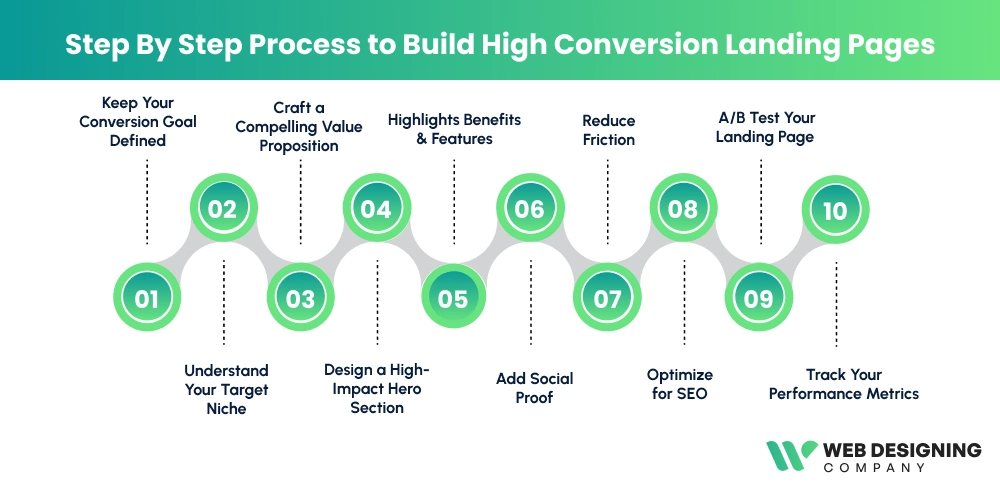
Step 1: Keep Your Conversion Goal Defined
Each landing page needs to be focused so it can work towards a similar yet specific business goal, such as lead generation, product purchase, webinar registration, and free trial signups. By having multiple goals, a business can confuse visitors and may experience missed conversion opportunities.
Step 2: Understand Your Target Niche
Having successful landing pages helps the business speak directly to the audience’s pain points, and you can easily identify customer problems, desired business outcomes, motivations, and objections. When you understand the audience, you craft a business message that resonates with the market, and so it brings results.
Step 3: Craft a Compelling Value Proposition
Your value proposition explains why users need to choose your product or service. It needs to clearly communicate what you need to offer, who it is for, why it is valuable, and how it solves the business problem. The value proposition needs to be clearly depicted in the hero section of the landing page.
Step 4: Design a High-Impact Hero Section
The hero section is the first visible section of the landing page, as it must have a relevant headline, subheadline, CTA button, visual element, and trust signals. Here, visitors need to understand the offer within 5 seconds of landing on the page; otherwise, conversion will fail.
Step 5: Highlights Benefits & Features
After capturing attention, its required to explain the key benefits of the business product or service that include bullet points, icons, and short descriptions. It also focuses on how your solution improves the user’s life or business positioning in the market.
Step 6: Add Social Proof
Businesses must have proof of their work done; they have made successful completion in the past, showcasing statistical data. It includes having updated testimonials, case studies, customer statistics, media mentions, and social proof that increase credibility and reassures the potential customers about their expected outcome in the future.
Step 7: Reduce Friction
You need to remove anything that can distract visitors from converting, such as common distractions. You need to have a strong focus on navigation menus, too many links, unnecessary information, and landing pages that perform best while remaining focused on one section.
Step 8: Optimize for SEO
Although the landing pages are often perceived as paid traffic, SEO optimization helps businesses attract additional organic visitors. Our best practices include the keyword optimized headings, meta titles, internal linking, fast page speed, and mobile optimization.
Step 9: A/B Test Your Landing Page
Each landing page needs improvement, and all can be done through testing. Test elements and look for required changes in headlines, CTA, images, page layouts, and form length, helping the business identify variations to generate the highest conversion.
Step 10: Track Your Performance Metrics
To measure the success, you need to track important metrics that include conversion rate, bounce rate, time on page, click-through rate, and cost per conversion. By having an analytics tool, you can easily look for user behaviour and add modifications to optimize business opportunities.
Common Mistakes That Prevent Landing Pages from Becoming High Converting
Even the well-designed landing pages can fail generating conversion if they possess critical mistakes. Many businesses currently are focusing on designing, but they ignore user psychology, messaging, and conversion flow that influence user decisions. With an understanding of common pitfalls, you can avoid costly errors and can significantly improve your landing page performance.
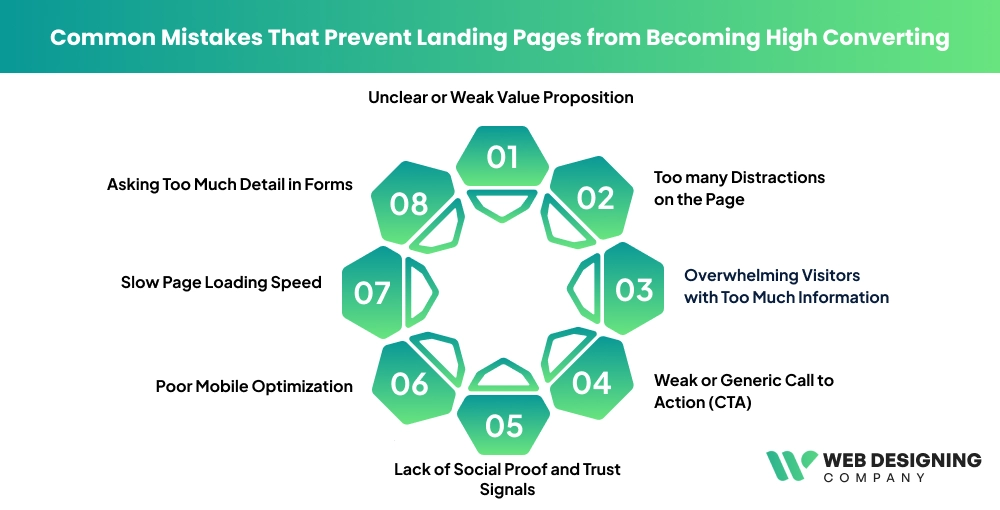
1: Unclear or Weak Value Proposition
One of the biggest reasons the landing pages fail to convert is that visitors don’t really get what the offer is about and what it’s there for. When users land on the page, they fail to decide within 5-8 seconds whether to stay or leave.
If the headline and the supporting message fail to communicate, the chances of abandoning the page automatically increase. A strong value proposition needs to answer three questions, i.e., what is being offered? Who is it for? Or why is it valuable or different?
Instead of presenting vague statements, you need to focus on clear benefits and the business outcomes that resonate well with the target audience and their present-time needs.
2: Too many Distractions on the Page
High converting landing pages are those that are designed keeping one clear goal in mind. And once the goal gets clearer, it helps remove unnecessary elements from the full website, such as navigation menus, multiple calls to action, and excessive links that lead users away from the page. These distractions create a decision of fatigue and reduce the likelihood of conversion.
3: Overwhelming Visitors with Too Much Information
Information delivery in terms of the landing page is important, but too much text or complex explanations can overwhelm the users. Visitors generally scan those pages rather than reading them in detail, if the content stays dense and difficult business can risk losing interest among the market.
For that, it is required that readability and engagementstays aligned, which breaks content into short sections, uses bullet points and subheadings, and highlights key benefits clearly.
4: Weak or Generic Call to Action (CTA)
Call to actions are those elements that help drive maximum conversions, yet there are many landing pages that use unclear CTA buttons, such as ‘ submit’, click here etc. These buttons are way more generic and fail to communicate the value of taking appropriate action.
5: Lack of Social Proof and Trust Signals
Visitors need familiarity with the brand to convert, and that comes from trust signals, which offer credibility. Those landing pages generally lack testimonials, case studies, customer reviews, or recognizable client logos struggles to build a strong yet trusted foundation in the market.
6: Poor Mobile Optimization
A large portion of web traffic generally comes from mobile devices, and those businesses that fail to optimize for mobile users end up losing potential conversions. The common mobile optimization concerns include text that is difficult to read, buttons that are too small, forms that are difficult to complete, and slow page loading speeds. Once the landing page starts providing a seamless experience across all devices, it helps users to convert easily regardless of how they access the page.
7: Slow Page Loading Speed
Page speed plays a critical role in user experience and generating conversions. If a landing page takes too long to load, visitors can leave before even noticing the content. You won’t believe it, but even a few seconds of delay can significantly increase bounce rates. To improve the page speed, you need optimization, compress images, minimize unnecessary scripts, and use reliable hosting and caching systems.
8: Asking Too Much Detail in Forms
It is totally understandable that forms are essential for lead generation, but overly complex forms can discourage users from completing the details. If you share a request for form filling with too many details, visitors might perceive the process as time-consuming or abandon the page. Keep your form simple and short, asking only for relevant information such as name, email address, and one more detail that is relevant to your query input.
Why Are High Converting Landing Pages Important?
Landing pages play a crucial role in the marketing field as they directly connect with the target market. No matter which mode of approach you prefer, such as PPC or SEO, the relevance of the landing page never diminishes its presence.
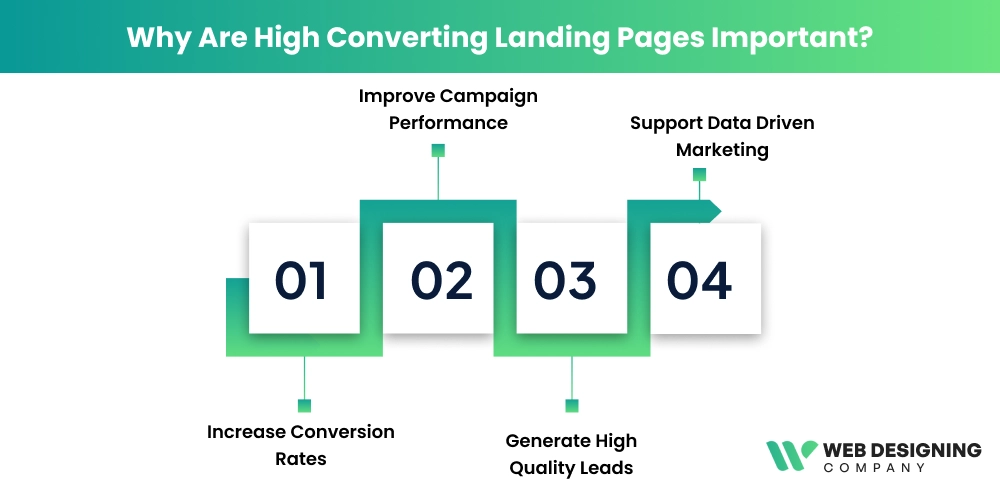
Increase Conversion Rates
If the landing page is designed appropriately, focusing on the market’s search intent, it directly improves conversion rate and the business’s lead closing score.
Improve Campaign Performance
Landing pages need to combine with ads or market campaigns to ensure visitors feel they landed on the right website that fulfills the requirement.
Generate High Quality Leads
If you work with a targeted landing page, they help you collect valuable information from potential customers through form fillings and actions they take.
Support Data Driven Marketing
Landing pages allow marketers to conduct A/B tests, measure engagement, and continuously optimize for business performance.
Conclusion
High converting landing pages are not created by chance; they result from making strategic planning, clear messaging, user-focused design, and constant optimization. In today’s competitive digital landscape, businesses can no longer rely on generic web pages; they develop intent-driven landing pages that persuade the market and align well with the market’s expectations.
How can you say your landing page is good and well-defined for making maximum conversions? To answer this, you would define business goals and have a deep understanding of the target market, so you can design a landing page that meets audience requirements, pain points, and motivations.
Trust and credibility are equally important for the business. So don’t miss incorporating testimonials, case studies, client logos, and other social proof, which reassure the visitors about the brand’s performance and capability of delivering the promised results. At the same time, work on eliminating the distractions present, simplify the forms, ensure fast page loading speeds, and reduce friction in the user journey that improves the conversion closing rate.