


It’s tiring to have repeated advice on web design and SEO that you should focus on making your site mobile-friendly, optimized, and improved in terms of page speed. But what’s new can help you embark on your business growth journey? Don’t need to figure it out on your own, because all these are basics that still matter, but in 2026, search engines will evaluate websites in a far more intelligent way. The presence of modern algorithms analyzes user behaviour, engagement signals, interface friction, and content accessibility, determining which page needs or deserves to be in the top search rankings.
Search engines like Google prioritize websites which create a seamless digital experience and prioritize quality rather than just containing optimized keywords. And due to this, web design has become a core SEO strategy rather than just a visual element. In this guide, we help you explore the deeper ways the web design impacts SEO, and what factors businesses and marketers are still overlooking.
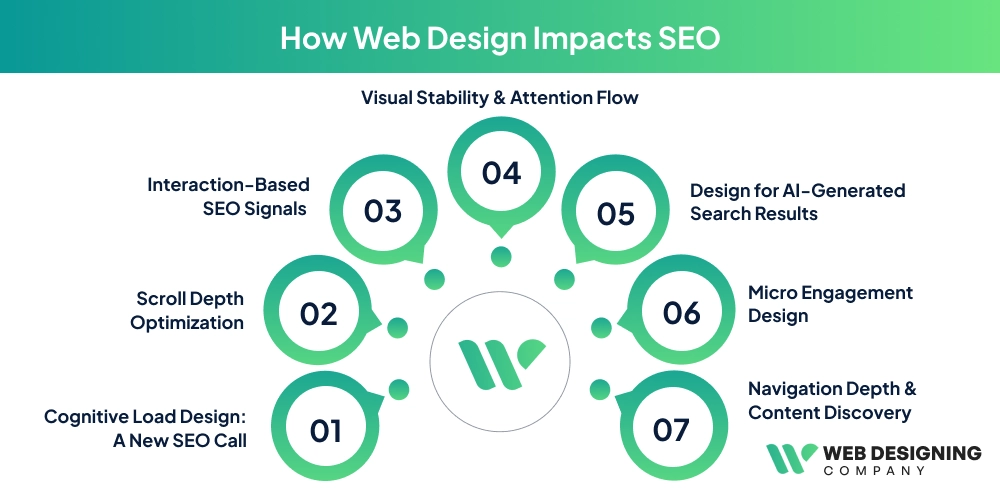
1: Cognitive Load Design: A New SEO Call
Talking about one of the most overlooked design factors that directly affects SEO is the cognitive load, which generally refers to how easily users can process the information on a page. When the visitors land on the website, their brain easily evaluates whether the page feels interactive, trustworthy, or easy to navigate. When the design feels overwhelming, users abandon the site immediately.
Search engines nowadays detect user behaviour through their engagement signals. A website with a high cognitive load includes the most crowded layouts, executive color grading, font styles, and too many CTAs. Also, the content of the website looks poorly aligned. Here users struggle to make sense of the business and exit the page quickly. It leads to shorter session durations and weaker SEO signals.
Tip: Designing a website with low cognitive load improves the whole SEO and makes the content easier to consume. Here are key strategies that include all clear visuals, consistent design, limited color infusions, focused call to actions, and structured content blocks.
2: Scroll Depth Optimization
Generally, SEO discussions start and end on the clicks, but in modern times, search algorithms emphasize making scroll-based behaviour analysis. Scroll depth measures how far users can travel down the page before leaving the site. If the visitors consistently abandon the page after the first screen, the search engine might interpret this as a sign that the content is not engaging or appropriate for the niche.
The ideal web design encourages its users to scroll deeper through visual storytelling, content segmentation, interactive elements, strategic use of whitespace, and progressive information flow.
Instead of placing all information at the top, web design should have seamless and effective distribution of value throughout the page. This technique encourages users to explore the full page, increases engagement signals, and boosts SEO performance.
3: Interaction-Based SEO Signals
User interaction is all that online businesses and websites need to make ROI, and this is also known as a powerful ranking signal. Search engines these days measure how users interact with the page elements, such as button clicks, menu navigation, video engagement, accordion expansion, and form interactions.
Websites’ main purpose is to derive meaningful interaction while making stronger engagement signals to search engines. For example, a website with highly interactive content sections, expandable FAQs, a calculator or tools, and interactive comparison tables can naturally generate higher engagement than a static page. Knowing such interactions, users can actively engage with the content rather than passively viewing it.
4: Visual Stability & Attention Flow
A maximum usability problem in modern web design is its visual instability, where all elements can shift unexpectedly while the page loads. These issues need to be constantly monitored through metrics related to core web vitals. Having unexpected layout shifts can often happen when images load without any defined dimensions and banners appear out of the blue, fonts change, and dynamic elements push content down.
Beyond technical metrics, modern SEO increasingly evaluates the attention flow and how smoothly it can proceed through a page.
5: Design for AI-Generated Search Results
Search is shifting rapidly with the rise of AI-generated summaries. Businesses took the assistance of AI-powered tools, pulling information from structured web pages to generate the answers. The gist of this section is to have a website that has AI readability as well as a human friendly system.
Web design plays an important role in this process, where search engines rely heavily on structured elements such as clear headings, FAQ sections, structured lists, semantic HTML, and schema markup. Websites that organize information clearly are more likely to appear in AI-generated summaries and feature search results.
6: Micro Engagement Design
Another emerging factor in SEO performance is its micro engagement. This refers to small interactions which keep users subtly included throughout a page, such as hover animations, scroll-triggered effects, dynamic content reveals, animated icons, and subtle feedback when clicking buttons.
These interactions create a feeling of responsiveness and modern design. While it may seem minor, its contribution is needed for longer sessions and improved user satisfaction.
Those websites that have cracked the design and SEO game can use micro engagement sparingly to enhance the browsing experience without impacting the performance overall.
7: Navigation Depth & Content Discovery
Many websites lose their SEO potential because their content is difficult to discover. Search engines generally prioritize websites where users can easily navigate multiple pages. A good web design encourages the users to discover its content, guides them from one page to another, following the navigation.
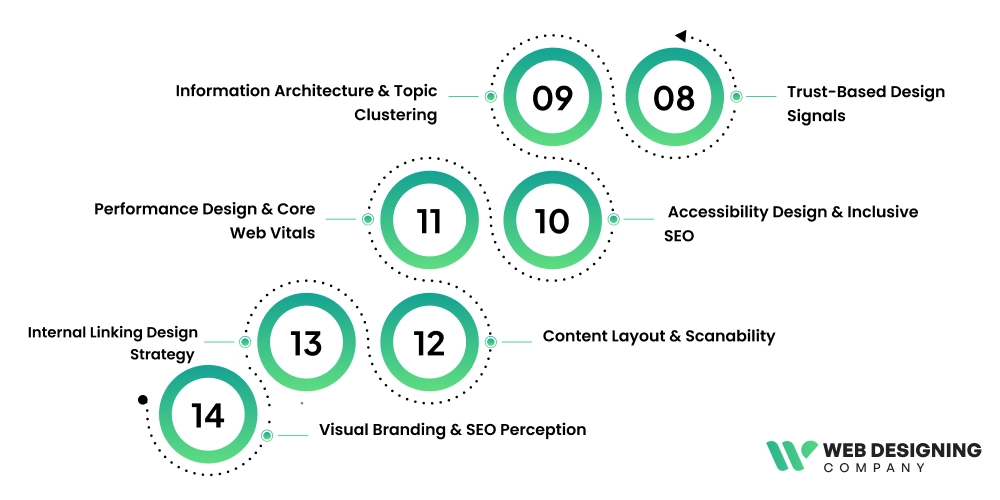
8: Trust-Based Design Signals
Trust is never a compromising factor in SEO, especially for business websites. Those users who subconsciously evaluate market credibility can evaluate the design quality and progress. A website that lags in design may appear outdated or unreliable, even if the content is not that accurate.
Trust-led design includes professional typography, consistent branding, secure HTTPS connections, clear contact details, genuine reviews, transparent business details, and more.
A website that feels credible keeps visitors staying longer, reducing the bounce rate while strengthening SEO signals.
9: Information Architecture & Topic Clustering
Modern SEO is not just about having individual pages ranking for different keywords. Currently, SEO evaluates how well the entire website organizes information, and what architecture they follow that aligns well with web design.
The information architecture refers to how pages are aligned in groups and how they are all connected across a website. A well-organized structure helps both the users and the search engines to maintain their connectivity and sync among topics.
10: Accessibility Design & Inclusive SEO
Accessibility is becoming an important factor across modern web design and SEO. If the website is easily accessible, it includes multiple disabilities following easy navigation, and allows users to consume content. Search engines work with increased favor websites that follow accessibility standards and provide an overall better user experience.
To have seamless accessibility, the key elements include proper use of semantic HTML, descriptive alt text for images, keyword-friendly navigation, clear contrast between text and readable typography, and font sizes.
11: Performance Design & Core Web Vitals
Website performance directly affects its ranking. Google introduced performance metrics, which are known as core web vitals, to measure real user experience. This metric evaluates the largest contentful paint, interaction to next paint, and cumulative layout shift.
In web designing, decisions significantly affect these metrics, such as large hero images, which can slow down LCP, heavy scripts can affect responsiveness, and unstable layouts, which can cause high CLS scores.
12: Content Layout & Scanability
Most users aren’t willing to create web pages word for word, instead they just look at the content headings and how the structure is going and where the relevant information is placed. A good web design supports scanability through heading placement, short paragraphs, bullet points, highlighted key ideas, proper spacing, and whitespace. When the user quickly understands the page-structuring, they are more likely to stay longer and explore additional sections.
13: Internal Linking Design Strategy
Internal linking is generally treated as an SEO tactic, but it also needs design elements. A website that is well designed naturally guides its users towards content following internal links. For example, it includes related articles, contextual links, recommended resources, and breadcrumb navigation. The internal linking here helps search engines discover deeper pages, improving user journeys while exploring additional information.
14: Visual Branding & SEO Perception
Although the branding is wholesome and associated with the marketing, it also affects SEO performance indirectly. Users these days subconsciously work on business credibility ,within that include consistent color themes, professional typography, clean layout structure, high quality structure, and high quality business visuals.
When a website looks conventional and doesn’t hook with the audience interest, the bounce rate increases, and engagement hampers. A strong visual identity of a website helps to build trust, improves engagement and strengthens the SEO signals.
All in All,
In 2026, web designing is not just about having a visually appealing website. It is a critical part of how search engines evaluate, rank and recommend web pages. Search engine and its evolving algorithm notices the user behaviour, its interaction patterns, content accessibility and performance signals which play a much bigger role in announcing SEO success.
Search engines such as Google, Bing and all prioritize websites that deliver meaningful user experience rather than simply focusing on keyword optimization. Elements like cognitive load, scroll engagement, visual stability, navigation depth, and micro interactions influence how users interact with websites and how these interactions send important quality signals to search engines.
The websites which succeed in organic search focus on clarity, usability, performance and structured information. By aligning the web design business can create digital experiences that satisfy both the users and search engines, leading to stronger visibility and higher engagement.