


When business experience falls short in leads, revenue, or need-based targeting, one reason could be adding service without a strong presentation. Then you look for website redesign services, and it’s a step forward. There are many businesses that quietly take a step backward, especially when organic traffic starts dropping within days of launch. But the reality is now simple: most website design fails because they never looked at it from an Search Engine Optimization perspective. And it’s not really about poor design, but because of critical search signals, URL, content structure, internal links, and authority, which might disrupt the process.
Search engines don’t really understand the better design. It understands the consistent effort, relevance, and trust. And when those signals change too fast, rankings start disappearing almost overnight. Through this blog, you will learn the effective approach to redesign as a controlled SEO migration, preserve your existing ranking, and even use the process as an opportunity to drive stronger organic growth.
Why Website Redesigns Often Lead to Traffic Loss ( How to Prevent)
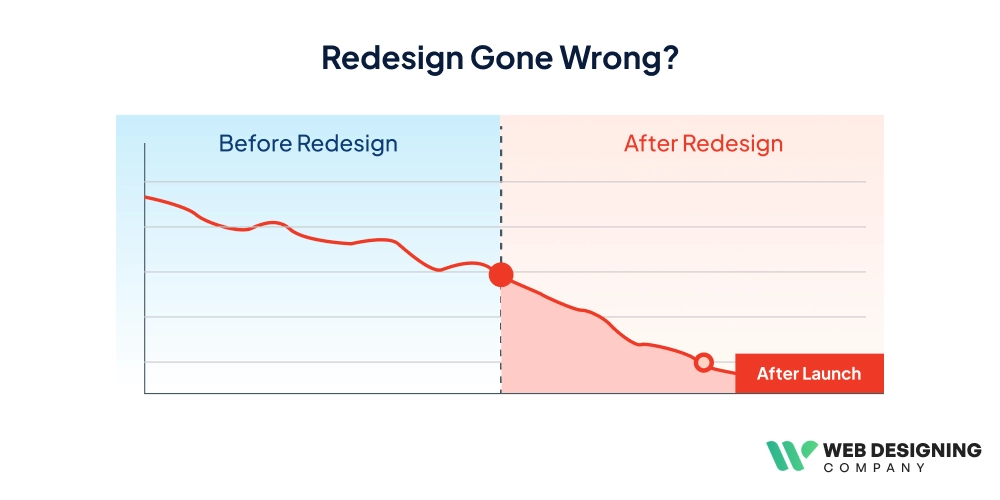
A website redesign is not just about changing the website’s look and appeal, but it also improves how search engines understand it. When businesses redesign, their focus is limited to visual appeal, brand consistency, and user experience. But what search engines evaluate is entirely different; it depends on ‘how your content is structured’, ‘how pages are connected’, and ‘how authority flows across your site’.
In terms of SEO, redesigning a website is not a vanity upliftment; it’s a full-scale migration of signals. Every URL, every internal link, or every piece of content carries weight to rank online. If the signals are altered, removed, or weakened without any clear strategy, search engines may no longer trust the site in any way. And the reason businesses face sudden ranking drops, deindexing of pages, loss of keyword visibility, and decline in organic leads.
SEO is not visual — It is structural
One of the biggest misunderstandings it has with redesigning a website is to assume ‘a better-looking website will automatically perform better in search’. Search engines don’t really witness design the way users do. They don’t really care about color palettes, animations, typography, and visual layout. Instead, SEO interprets your website through structure and signals.
How Search Engines Actually Interpret Your Website
What a normal person can think about a website, that is not the same for SEO. It interprets websites at different measures, and among those websites, the look doesn’t really matter.
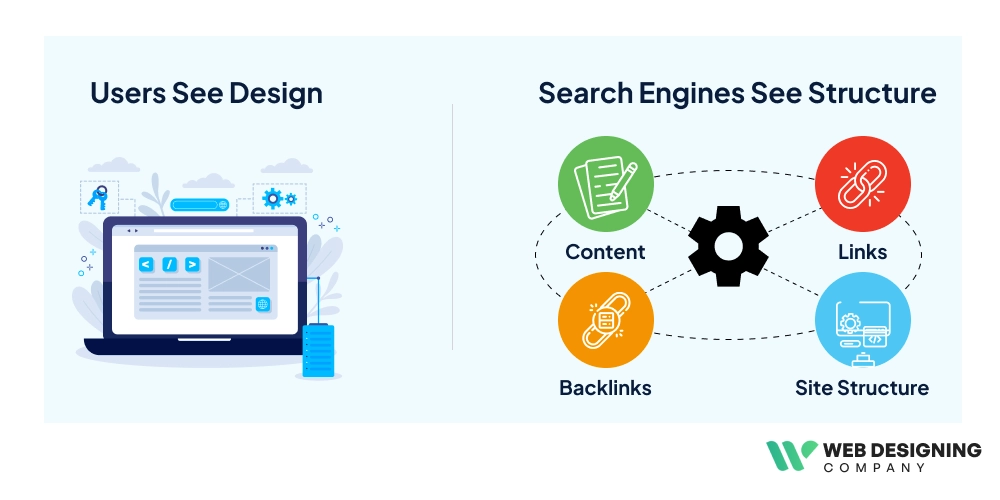
1: The relevance of Content
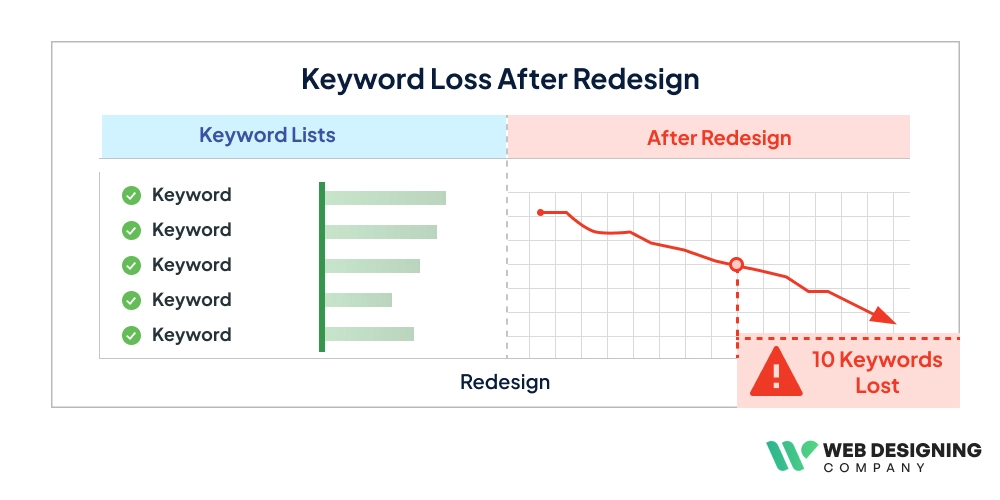
Search engine identifies the keywords, phrases, topic coverage, content depth, clarity, and the semantic relationships between terms. If you redesign your website, remove or rewrite content, you may unintentionally reduce the relevance of keywords, lose long tail keywords, and break topical depth.
2: Authority Links
Links actually help search engines to understand which pages are important, how authority flows, and how content is related to the business offerings. This also includes internal linkings, external backlinks, but while redesigning internal linking might get removed and reorganized, navigation changes alter link flow, and some pages lose their incoming links entirely.
3: Structuring of the website
The structure of the website tells search engines how organized the website is. Which pages are primary v/s secondary, and how easily can content be discovered? And it includes the URL hierarchy, navigation, and page depth. If your redesign changes the structure, it includes pages, crawl efficiency drops, and some pages may not get indexed properly.
*Redesign might improve user experience, but it thoroughly disrupts content relevance, link placement, and equity, and structural clarity. And due to this, a search engine may interpret your site as less authoritative or less relevant.
What Actually Breaks During Website Redesign?
Even the well-designed landing pages can fail generating conversion if they possess critical mistakes. Many businesses currently are focusing on designing, but they ignore user psychology, messaging, and conversion flow that influence user decisions. With an understanding of common pitfalls, you can avoid costly errors and can significantly improve your landing page performance.
URL Changes (Your Biggest SEO Risk)
Each URL on your website holds accumulated SEO value. It includes ranking in terms of search results, backlinks from external sites, and historical performance signals. When you change a URL, your search engine starts treating it as a whole new page. And you will keep wondering.
Where did you go wrong?
And the mistake lies in where URLs are modified for a cleaner structure. Categories are reorganized without SEO planning, and slugs are rewritten for branding purposes.
What’s the hack?
You need to keep your URLs unchanged whenever possible. If the changes are necessary, you need to use 301 redirects as a permanent redirect. It will ensure the old URL points to the most relevant new page.
Missing Redirects (Silent Traffic Killer)
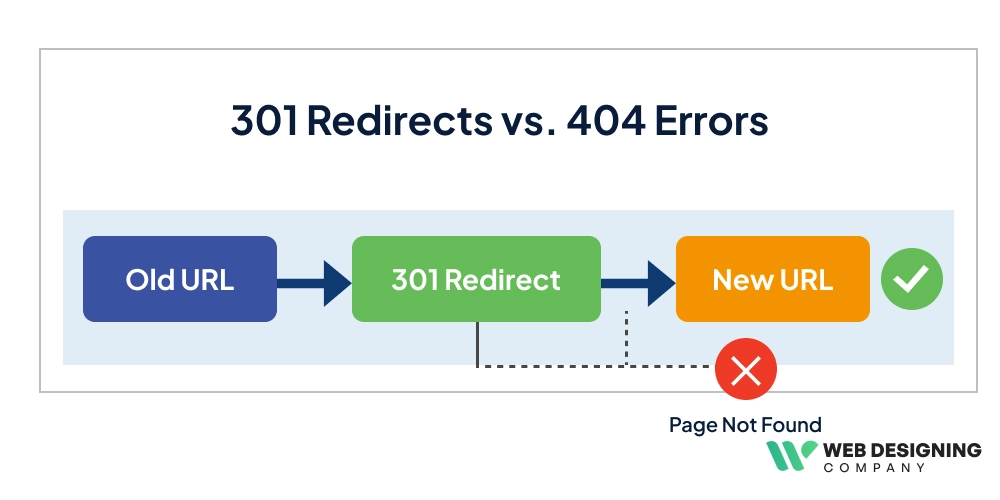
Redirects act as a bridge between your new and the old websites. Without them, users land on 404 errors, search engines lose track of your pages, and backlinks start diminishing their value.
Where did you go wrong?
If the website fails to design any seamless redirect planning, only a few important pages are redirected, or if the redirection happens to the irrelevant pages. Then there would be huge confusion and an intent mismatch.
What’s the solution?
You need to build a complete redirect mapping document before its launch, or you can use only 301 redirects for a permanent change. You need to cross-verify all redirects before making them live.
Content Extraction & Dilution (Hidden Ranking Drop)
When redesigning of the website is redesigned, content is often shortened for a better UX, simplified for better readability, and removed to make pages look cleaner. While this might improve the design, it somehow weakens the SEO.
Where did you go wrong?
If the relevant content gets eliminated from the website, it reduces the keyword coverage, long tail rankings start disappearing, and topical depth is reduced. Even if you remove small sections from the pages, it will have a direct impact on rankings.
What’s the solution?
To prevent this, audit content before removing anything without analysis. Rankings will only be preserved if the content is richer in keywords across sections. While merging the pages, make sure no keyword intent is lost.
Internal Linking Disruptions (Loss of Authority Flow)
Internal linking of the website depends on how SEO values the site’s credibility and authenticity. This helps search engines to discover pages, understand page importance, and to establish content relationships.
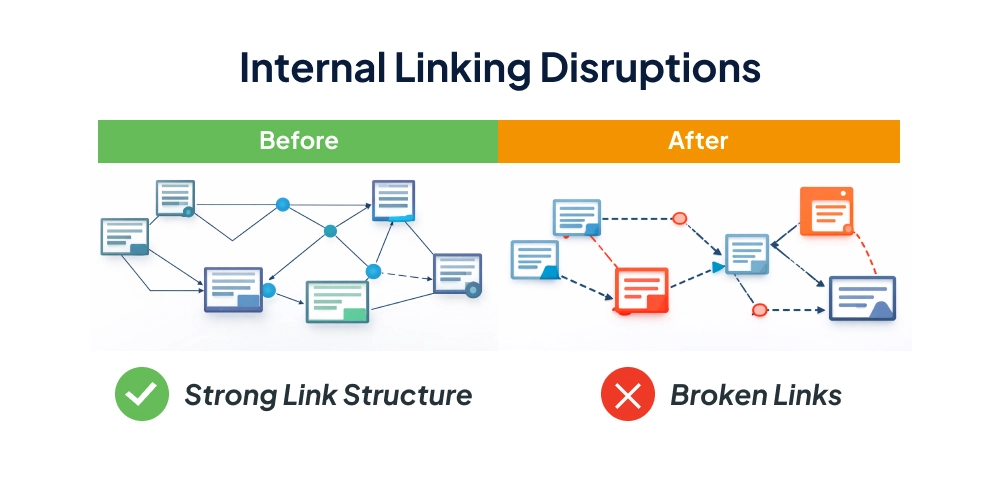
Where did you go wrong?
Sometimes, while upgrading or redesigning the website, the links are removed to keep the website simple and easy. The navigation changes on the website access key pages, and the anchor text becomes generic or irrelevant. Due to this, important pages lose their authority, crawl paths become weaker, and rankings start declining gradually.
What’s the solution?
You need to audit the whole existing internal links, try to recreate them in the new, desikeyword-richain keyword rich anchor text for no harm.
Technical SEO Issues (Invisible But Dangerous)
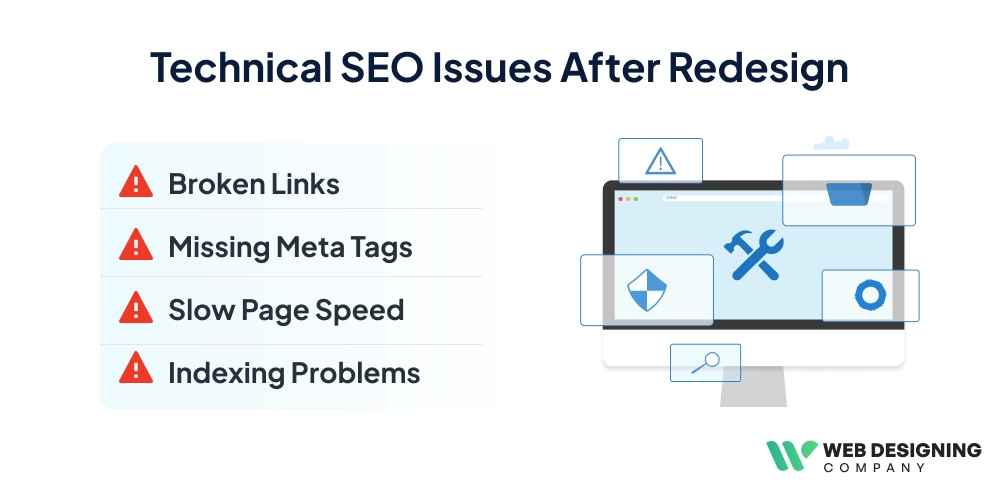
Redesign often invites technical errors, and they are not immediately visible, but they are highly impactful in terms of rankings. The common issues they cause are broken links, incorrect canonical tags, pages accidentally set to ‘noindex’, slow loading speeds, and JavaScript blocking content.
Where did you go wrong?
Search engines generally rely on tech performance of websites. It impacts crawling over the site, index pages, and evaluating business performance. Even small technical errors lead to de-indexing of the pages, reduced crawl frequency, and ranking drops.
What’s the solution?
To prevent this, you need to run a complete technical web audit on staging, crawling over new websites, and to fix all errors proactively, you will only then be set to expect success.
Proceed With Right Foundation That Protects Your Rankings
Now you are already aware of those parts that are breaking your website SEO and performing while redesigning, and the next step is to ensure those mistakes never happen in the first place. And the primary step that needs to be taken is a ‘pre-redesign SEO audit’.
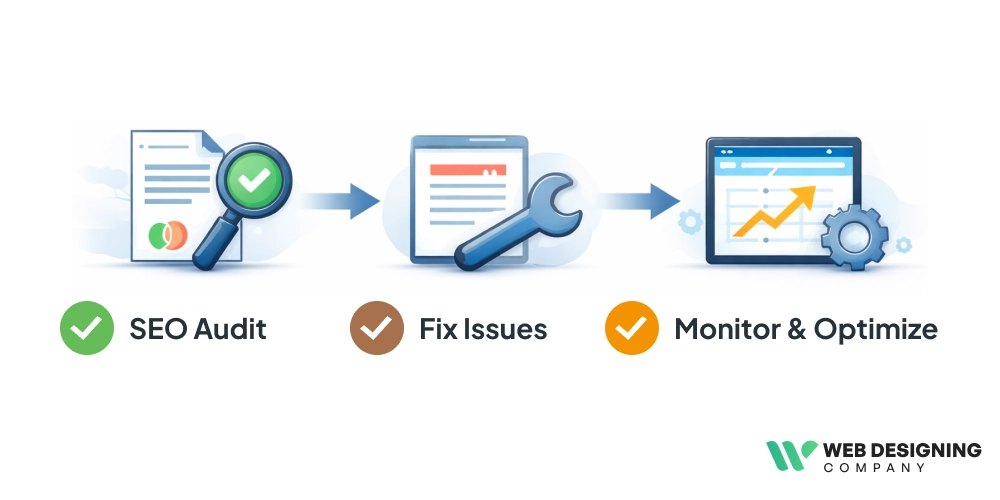
Pre-Redesign SEO Audit
Because you can not protect rankings if you are not aware of where they are leaking. And this is where most businesses fail. They jump straight into redesign without even understanding. And to fix the problem, sometimes the relevant elements get removed that were actually helping them to rank. That’s why the need of having a pre-designated SEO audit is not just important but also non-negotiable. It acts as an SEO safety system, ensuring the website evolves visually, and search performance remains stable or expects improvements.
Identify High Value SEO Pages
Not all important pages have high traffic. But still, a page can count as valuable if it has valuable backlinks, drives expected conversions, converts conversions, and supports other page traffic. Some low-traffic pages actually have a high impact in terms of SEO assets, so it would be a mistake to take them lightly.
Advanced Insight: SEO Value Score
To make a smarter decision, you need to evaluate pages based on traffic, backlinks, conversions, and engagement. By evaluating all, businesses can identify stages that must be preserved while redesigning.
Curate a Complete URL Inventory (Your SEO Blueprint)
Before redesigning, you need to create a complete list of all URLs that include the details of all pages, their status, and metadata. By using a pro strategy, you need to make calculations over traffic, backlinks, and rankings. It turns your list into a decision-making system.
Benchmark Your Current SEO Performance
Don’t rush to alter your web pages and their appeal until you capture keyword rankings, organic traffic, CTR, and indexed pages. It will help you stay on the safer side without losing your existing web presence.
In Conclusion,
A website redesign is often confused as a visual upgrade, but in actuality, it needs to be considered as the most sensitive phase for a website in terms of SEO. It is not just about how it looks; it is about how search engines continue to understand, trust, and rank your content. And the ideal difference between a successful redesign and a failed one comes from one thing: You treated website design upgradation as a project or as an SEO migration.
Some businesses learn or consider it too late, and they invest heavily in redesign, better UI, modern layouts, and improved user experience. But within days of web design upgradation, you start witnessing traffic drops, rankings disappear, and leads start declining. And here, the role of pre-redesign audit helps protect high values, preserve authority, and avoid removing key SEO drivers. Act smarter, rather than just redesigning the website, you need to change your approach with the right execution that strengthens SEO, not loses it.